
07 September, 2026
The story of Prophet Nuh (Noah), peace be upon him, is one of the most powerful stories mentioned in the Quran. It teaches Muslims about patience, faith, obedience to Allah, and the consequences of rejecting the truth. The story of Noah's Ark is described in several chapters of the Quran, including Surah Hud, Surah Nuh, Surah Al-Mu'minun, and Surah Al-Anbiya.
Prophet Nuh (Nuh عليه السلام) was sent by Allah to guide his people back to worshipping Him alone. His people had turned away from monotheism and followed false gods.
The Quran records Nuh's message:
“O my people, worship Allah; you have no deity other than Him.”
(Quran 7:59)
Prophet Nuh called his people to worship Allah alone and abandon the idols they had been worshipping. He continued to warn them, but many refused to listen.
Prophet Nuh showed remarkable patience while calling his people to Allah. The Quran tells us that he remained among them for 950 years:
“And We certainly sent Noah to his people, and he remained among them a thousand years minus fifty years.”
(Quran 29:14)
During this long period, Nuh used different ways to communicate his message. He called his people publicly and privately, at night and during the day.
In Surah Nuh, he says:
“Then I invited them publicly. Then I announced to them and also confided to them privately.”
(Quran 71:8–9)
Despite his efforts, many people continued to reject his message.
Nuh's people did not simply reject his message; they also opposed him and refused to abandon their idols. The Quran mentions some of the idols they followed:
“And they said, ‘Never leave your gods and never leave Wadd or Suwa' or Yaghuth and Ya'uq and Nasr.’”
(Quran 71:23)
Their continued rejection eventually led Allah to inform Nuh that no more of his people would believe except those who had already believed.
Allah said:
“And it was revealed to Noah that no one will believe from your people except those who have already believed.”
(Quran 11:36)
Allah then commanded Prophet Nuh to build the Noah's Ark under His guidance.
The Quran says:
“And construct the ship under Our observation and Our inspiration and do not address Me concerning those who have wronged; indeed, they are [to be] drowned.”
(Quran 11:37)
The people mocked Nuh while he was building the Ark. However, he continued following Allah's command without allowing their ridicule to weaken his faith.
This part of the story demonstrates the importance of trusting Allah even when His command may not immediately make sense to others.
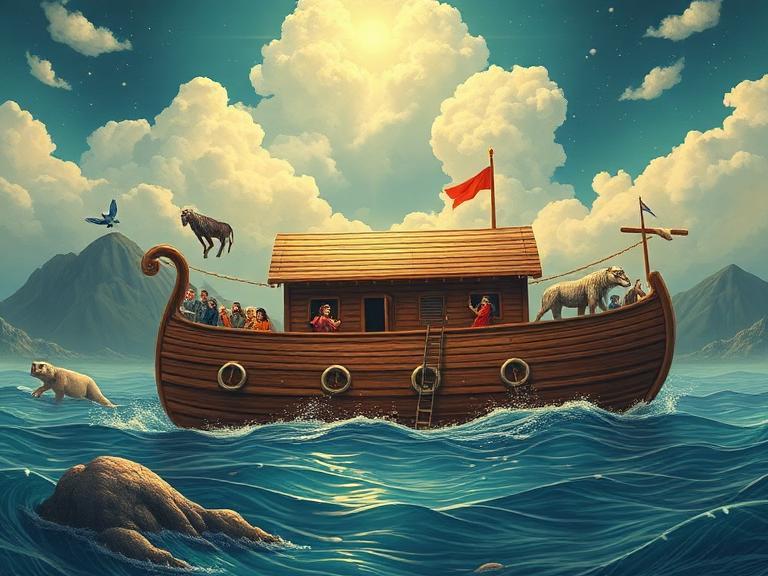
When Allah's command came and the flood began, Nuh was instructed to take aboard the believers and pairs of creatures.
The Quran describes the moment:
“So We said, ‘Load upon it of each [creature] two mates and your family, except those about whom the word has preceded, and [include] whoever has believed.’”
(Quran 11:40)
The Ark then moved through enormous waves. The Quran describes them as being like mountains:
“And it sailed with them through waves like mountains.”
(Quran 11:42)
The believers were saved aboard the Ark, while those who rejected Allah's message were overwhelmed by the flood.
One of the most emotional parts of the story occurs when Nuh sees one of his sons separated from the believers.
Nuh calls to his son and tells him to board the Ark:
“O my son, come aboard with us and be not with the disbelievers.”
(Quran 11:42)
His son refuses and believes that he can escape by climbing a mountain. Nuh responds that nothing can protect someone from Allah's command except those upon whom Allah has mercy.
A wave then comes between them, and his son is among those who drown.
This part of the Quranic story shows that faith and righteousness cannot be inherited simply through family relationships. Each person is responsible for their own response to Allah's guidance.
After the flood, Allah commanded the earth to absorb its water and the sky to stop raining. The Ark eventually came to rest on Mount Judi.
The Quran says:
“And it was said, ‘O earth, swallow your water, and O sky, withhold [your rain].’ And the water subsided, and the matter was accomplished, and the ship came to rest on the [mountain of] Judi.”
(Quran 11:44)
The believers were then able to leave the Ark by Allah's command.
The story of Noah's Ark contains important lessons for Muslims. Prophet Nuh demonstrates extraordinary patience despite centuries of rejection. His story teaches that believers should continue doing what is right even when they face opposition.
The story also emphasizes the importance of sincere faith, obedience to Allah, and avoiding arrogance. Nuh's people had access to repeated warnings but chose to reject them.
Another important lesson is that Allah's protection comes through obedience and faith. Nuh followed Allah's command to build the Ark, even when people mocked him.
Who was Prophet Nuh?
Prophet Nuh (Noah), peace be upon him, was a prophet and messenger of Allah who called his people to worship Allah alone.
Where is the story of Noah's Ark mentioned in the Quran?
The story appears in several chapters, especially Surah Hud, Surah Nuh, Surah Al-Mu'minun, and Surah Al-Anbiya.
How long did Prophet Nuh preach to his people?
The Quran states that Nuh remained among his people for 950 years (Quran 29:14).
Where did Noah's Ark come to rest?
According to the Quran, the Ark came to rest on Mount Judi (Quran 11:44).
What is the main lesson of Noah's Ark in Islam?
The story teaches patience, faith, obedience to Allah, and the importance of accepting divine guidance even when others reject it.
Did all of Prophet Nuh's family enter the Ark?
No. The Quran specifically mentions that one of Nuh's sons refused to board the Ark and was drowned in the flood (Quran 11:42–43). The Quran also explains that the family member excluded from Allah's promise was not considered among the righteous (Quran 11:46).
