
28 February, 2026
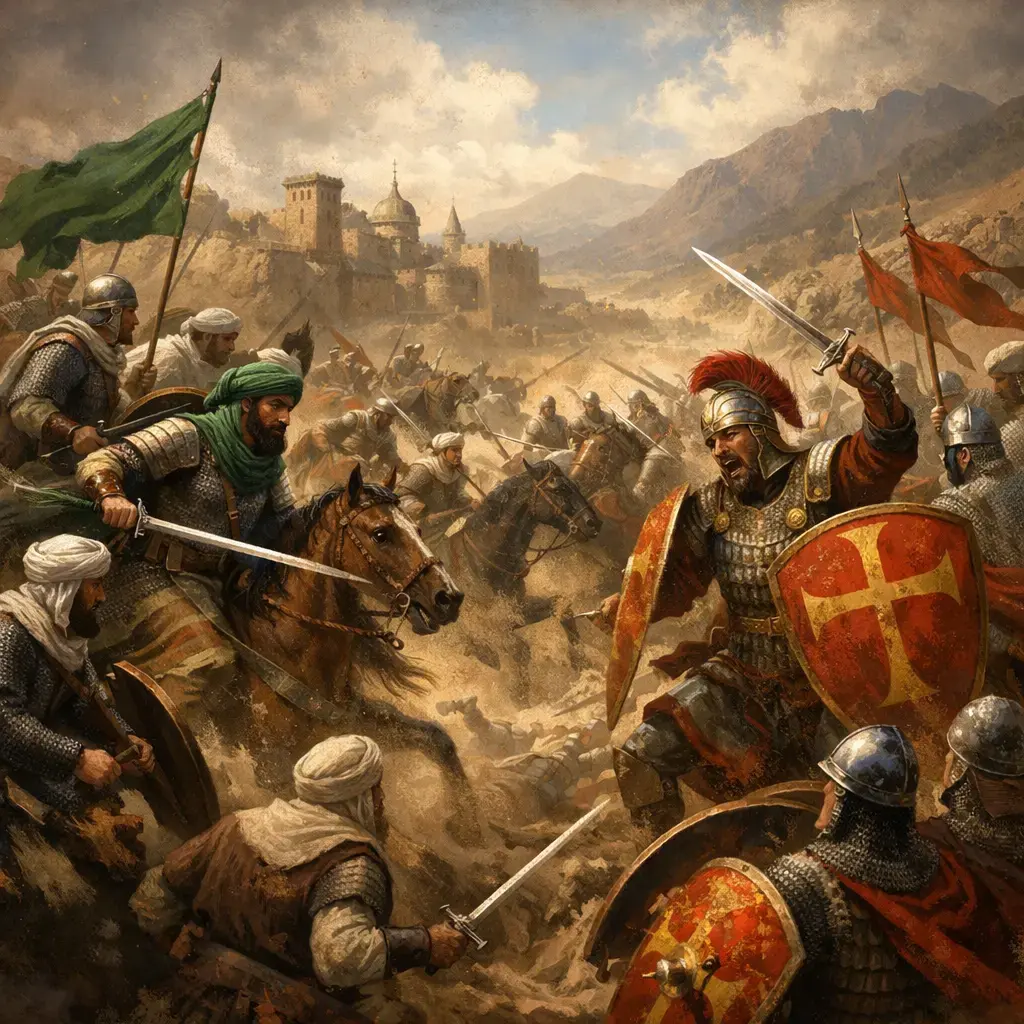
The Battle of Mu'tah was a pivotal 629 CE confrontation between the early Muslim army and Byzantine forces in present-day Jordan. Despite heavy losses, Muslim troops demonstrated resilience and strategic withdrawal, marking the first major clash with Byzantium.
The immediate cause of the Battle of Mu'tah was the killing of Al-Harith ibn Umayr, the Prophet’s envoy, by Shurahbil ibn Amr al-Ghassani. Diplomacy in Arabia and the Levant followed strict customs, and killing a messenger was viewed as an act of war. The mutah battle therefore represented both a political and military message: the Muslim state would defend its envoys and assert its authority beyond the Arabian Peninsula.
Strategically, the Battle of Mu'tah marked the first direct engagement between Muslim forces and the Byzantine Empire. It was not merely a punitive expedition but also a calculated move to challenge Byzantine influence in the region and test the strength of northern alliances.
Before departing, the Prophet appointed three successive commanders for the Battle of Mu'tah:
-
Zayd ibn Harithah
-
Ja'far ibn Abi Talib
-
Abdullah ibn Rawahah
If one fell, the next would assume command. This structured succession played a critical role during the mutah battle as leadership changed rapidly under intense combat.
The Muslim army was disciplined and motivated but lightly equipped compared to the Byzantine forces. The Byzantine side included imperial troops and allied Arab Christian tribes, heavily armed and numerically superior. Despite this imbalance, the Battle of Mu'tah demonstrated the tactical resilience of the Muslim forces.
The Battle of Mu'tah unfolded with fierce fighting. Zayd ibn Harithah carried the banner and was killed early in combat. Ja'far ibn Abi Talib then took the flag and fought courageously until he was martyred, reportedly losing both arms while holding the banner during the mutah battle. Abdullah ibn Rawahah assumed command next and was also killed after intense fighting.
With three commanders fallen, the army selected Khalid ibn al-Walid as leader. His tactical brilliance became evident during the Battle of Mu'tah as he reorganized the troops, rotated flanks, and created the illusion of reinforcements. Through calculated maneuvers in the mutah battle, he prevented total annihilation and executed a strategic withdrawal.
Although the Battle of Mu'tah did not result in a decisive territorial victory, it was strategically significant. The Muslim army successfully disengaged from a much larger force while preserving its structure. Khalid ibn al-Walid earned the title “Sword of Allah” following the mutah battle due to his battlefield leadership.
The Battle of Mu'tah also marked a psychological turning point. It signaled to the Byzantine Empire that the Muslim state was capable of projecting military power beyond Arabia. In the long term, the mutah battle laid groundwork for future campaigns in the Levant during the Rashidun expansion.
From a military analysis perspective, the Battle of Mu'tah illustrates:
-
Leadership succession planning under combat pressure
-
Tactical withdrawal as a strategic success
-
Psychological warfare through battlefield maneuvering
-
The beginning of Muslim-Byzantine military engagement
The mutah battle is often studied as an example of how smaller forces can maintain cohesion against overwhelming numbers through discipline and command structure.
The Battle of Mu'tah ended without a clear battlefield victory for either side. While many Muslim commanders were killed, the army avoided destruction and withdrew strategically, making the outcome of the mutah battle a tactical survival rather than a decisive defeat.
